Facebook

Tuesday, 3 February 2026

The Parisian Coffee Culture

The Changing Coffee Culture of Paris

Paris has long been associated with cafés, yet the modern coffee shop culture—similar to what we see today in cities like New York, London, or Melbourne—is a surprisingly recent development in France.

Traditionally, Parisians drank a quick, strong espresso (pronounced “expresso” in French) standing at the bar counter. These coffees were often sharp or sour in taste, and the focus was on speed rather than experience. For decades, this model dominated everyday coffee drinking in France.

However, the situation has changed rapidly in recent years. Since 2010, the number of coffee shops in France has increased by approximately 74%, with growth accelerating significantly after the COVID-19 pandemic. This marks a clear shift in consumer expectations and urban lifestyle.

From Function to Experience

Until very recently, thoughtfully designed coffee shops were rare in Paris. According to architect Julien Sebban, who designed the popular Café Nuances, the real transformation began only after 2020–2021. Before that, Paris had very few cafés that combined quality coffee with modern interiors and a contemporary atmosphere.

Today, Parisians increasingly expect more than just a cup of coffee. Interior design, comfort, and visual appeal have become essential. Customers want spaces that feel current, welcoming, and worth spending time in—not places that feel frozen in the 1980s. Coffee is now as much about experience as it is about taste.

International Influence

A notable feature of this new wave is the strong presence of foreign entrepreneurs. Many of the newer coffee shops are run by Colombians, Americans, Koreans, and Mediterranean collectives. Examples include Colombian-run cafés like Flor de Café, American projects such as Bob’s Café, and Korean-inspired spaces like The Coffee.

This international influence has enriched menus and brewing styles but has also raised prices. A cappuccino in a modern Parisian coffee shop can now cost €6–8, reflecting both rising standards and higher operating costs.

Creativity as Survival

To stand out in a competitive market, coffee shops in Paris are becoming increasingly creative. Some cafés now double as cultural spaces:

Jörro Kaffé includes a podcast recording studio.

FCC hosts live DJ sets.

Café Pli offers a unique concept where customers can write a letter to themselves, to be delivered five years later.


A City Transformed

Just as there is “Paris before COVID and Paris after COVID,” there is also a clear divide between traditional café culture and today’s modern coffee shop movement. The transformation reflects broader social changes—global influence, visual culture, and the desire for meaningful, well-designed public spaces.

For visitors and coffee lovers alike, the message is simple: good coffee in Paris today is no longer found everywhere by chance. One must seek out dedicated coffee shops—but the reward is a richer, more contemporary experience.

Tuesday, 27 January 2026

Newspaper Day


Newspaper Day
A path-breaking day.
Colonial India Heritage Studies marks this occasion with joy and deep appreciation, celebrating the power of the newspaper as a witness to history, a voice of conscience, and a bridge between the past and the present.

Saturday, 17 January 2026

Amy Carmichael

In Memory of Amy Carmichael on her 75th Death Anniversary On January 18th. 

Living with her in our hearts,
The way she loved Jesus
A love that filled her with joy and peace,
A joy she lived to share with others.

From that love she found the strength
To do what seemed impossible,
To give a home,
To become a mother to the orphaned.

In Jesus she found courage
For every obstacle that crossed her path.
Remembering you, Amy,
Light and inspiration,
A model of love and quiet joy—
Teaching us to give everything
To what we are called to do,
Whatever our life’s circumstances may be.

Wednesday, 31 December 2025

Boxing Day in British India

A short story

Boxing Day — In British India

I work in a sahib’s bungalow.

On Christmas Day, the house wakes before the sun. The cook has been up all night. The bearer presses the sahib’s coat. The table is laid with things that do not belong to this land — roast meat, puddings, bottles wrapped in straw. Outside, the garden is still, as if it knows it is not invited.

We work without pause.
We always do.

The sahib goes to church. Guests arrive in motorcars and tongas. Laughter carries through doors we do not enter unless called. Plates come back half-eaten. What remains is more than what my home will see in a month.

By night, when the last glass is cleared, my hands smell of food I have not tasted.

The next morning is different.

No bell rings early. The bungalow is quiet. The sahib’s wife calls us one by one. There is no speech. No sermon. Only practice.

She gives me a parcel.
Wrapped in old newspaper. Tied with string.

Inside is cake — heavy, dark, rich. A woollen shirt that no longer fits the sahib. Some money, folded small so it does not look like much, but it is. It always is.

They call it Christmas gift.
We call it understanding.

By noon, I am walking toward the railway line. The train is crowded with others like me — cooks, bearers, sweepers — each carrying something wrapped, each guarding it carefully. No one opens anything yet.

At the village, they are waiting.

My mother touches the cloth first.
My father counts the money silently.
The children wait for the cake.

When it is cut, the knife moves slowly. This is not everyday food. This is food from another world. We eat it carefully, as if eating too fast might make it disappear.

For one evening, the sahib’s Christmas enters our house.

I know this day did not begin here. I have heard that long ago, in England, servants received boxes the day after Christmas. A man named Samuel Pepys even wrote about it in his diary — about giving money, about the cost, about the duty of it.

I understand him.

This day is not kindness.
It is not charity.
It is order.

Those who serve must return home with something. Otherwise, the year would feel unfinished.

Tomorrow, I will go back to the bungalow. The shirt will no longer smell of the sahib’s soap. The cake will be gone. The money will be saved for a harder day.

But tonight, Boxing Day has crossed oceans and centuries to reach my home.

And for that one night, the distance between the big house and the small one feels almost walkable.

Friday, 6 June 2025

The Distant Ripple of Normandy at Kochi


D-Day Remembrance | June 6

On this day, long ago, the winds and the birds that blew and flew over Normandy felt and heard not just the sounds of war, but also the heavy hope of a world yearning for peace.

Though thousands of miles away from those bloodied beaches, the impact of D-Day was deeply felt even in small colonial towns like Kochi, nestled along the Malabar Coast.

On the shores of Normandy, France, over 156,000 Allied soldiers—from the United States, United Kingdom, Canada, Australia, New Zealand, and Free French forces—landed under relentless fire. Many were barely out of their teens. They began that day not knowing if they'd live to see its end.

They did not fight for conquest. They fought through terror, steel, and fire to end the long night that fascism had cast over the world.

In 1944, Kochi was part of British India, tied closely to the fate of the Allied war effort. Families here waited anxiously for news—of sons, brothers, cousins—serving on faraway fronts. War updates crackled through All India Radio, arrived late on newspapers from Bombay, Madras, and Calcutta, and sometimes came in the form of fragile letters from the front that took weeks to arrive.

The Port of Kochi, strategically vital during the war, stood on high alert. Ships came and went. Supplies were loaded. British officers paced its piers. And the people of Kochi—shopkeepers, fishermen, schoolteachers—lived their days under the long shadow of a war that had reached their shores without ever dropping a bomb.

Today, we do not glorify war. We remember the cost of freedom.

Their bravery didn’t just shape the course of World War II—it gave us back the world we know today.

They died with names we may never know, but they live on in every quiet morning, every free election, every child laughing in peace.
Because of their courage, the war did not last another year.
Because of their sacrifice, millions more were spared.

Many young men from Kochi and across India served on multiple war fronts around the world. And back home, their families lived in silent worry, trying to hold together work, faith, and home, clinging to news—any news—that spoke of life.

Let us not reduce their memory to a paragraph in a textbook or a minute’s silence once a year.

Let us live our lives in a way that honours the gift they gave—
a world where peace is possible,
and justice can prevail.

🕯️ We remember them.
🕯️ We thank them.
🕯️ We vow never to forget.

On this day, we also honour the quiet resilience of communities like Kochi that bore the weight of a war fought on many fronts.

The sacrifices made on those distant beaches of Normandy shaped the future even here—
fuelling conversations about freedom and independence that would soon change India forever.


Monday, 30 December 2024

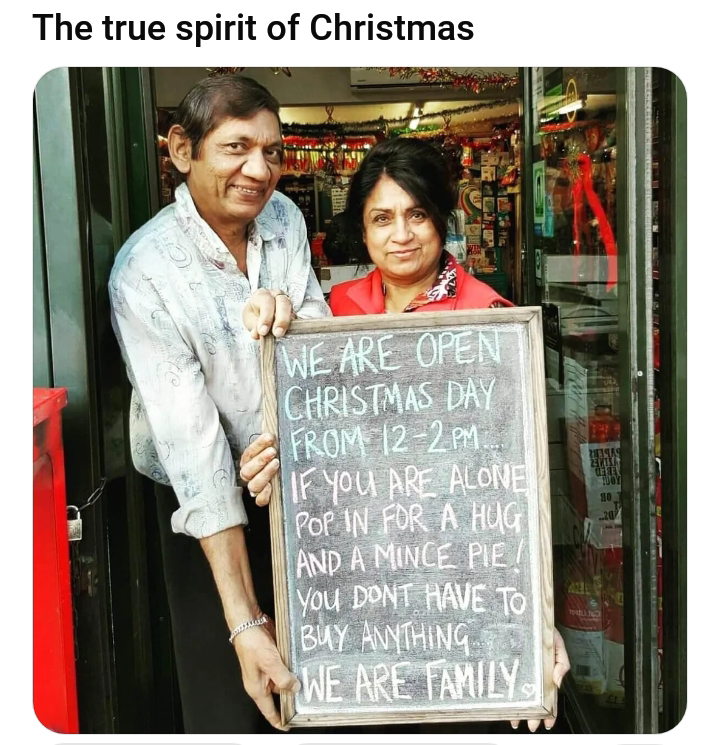
The True Spirit of Christmas


A Hindu family in the UK has been opening their shop on Christmas Day for the past 23 years to provide companionship to locals who might otherwise be alone during the holiday. The Patel family, who run the store in Seaton, Devon, offer free mince pies, sherry, and coffee to visitors. Their tradition began in 2000 when they noticed that some community members had nowhere to go on Christmas. The Patels' gesture has been warmly received, with many locals expressing gratitude for the sense of community it fosters.

Wednesday, 25 December 2024

The jingle bell story


Long ago, in the crisp winter of 1857, a man named James Lord Pierpont penned a tune that would echo through the ages. At the time, it bore the title "One Horse Open Sleigh," a lively melody inspired not by yuletide celebrations but by the thrill of sleigh races in Medford, Massachusetts. In those days, sleigh riders often tied jingle bells to their horses and sleighs—not for decoration, but for safety. The cheerful jingling alerted others to the sleigh's approach, especially in the snowy hush of winter when visibility was low. This simple precaution became the heartbeat of Pierpont’s joyous song, capturing the spirit of dashing through the snow.

The song made its debut at Boston's Ordway Hall, performed by Johnny Pell and the spirited Ordway's Aeolians. Though not originally written with Christmas in mind, it began its journey into history. In 1889, banjo player Will Lyle recorded it on an Edison cylinder, making it one of the earliest examples of recorded music. Unfortunately, that version is lost to time, but an early vocal rendition titled "Sleighride Party" survives, a testament to the song’s enduring charm.
In the decades that followed, "One Horse Open Sleigh" began to drift into the arms of the holiday season. By the 20th century, with the rise of phonograph records and radio, its merry tune found a home in the hearts of Christmas revelers. A pivotal moment came in 1943, when Bing Crosby and the Andrews Sisters released their rendition, sealing its fate as a timeless Christmas classic.

What began as a practical tool for sleigh rides, jingling to keep the snowy roads safe, transformed over time into a melody synonymous with the holiday spirit. From snowy sleigh rides in Massachusetts to carolers around the globe, "Jingle Bells" has jingled its way into the hearts of millions, a festive anthem of joy and cheer.

Original Lyrics

Dashing through the snow,
 In a one-horse open sleigh,
 O'er the fields we go,
 Laughing all the way.

 Bells on bob tail ring,
 Making spirits bright,
 What fun it is to ride and sing,
 A sleighing song tonight! 
 Jingle bells, jingle bells Jingle all the way Oh, what fun it is to ride,
 In a one-horse open sleigh, hey!
 Jingle bells, jingle bells Jingle all the way Oh, what fun it is to ride,
In a one-horse open sleigh! 
 A day or two ago,
 I thought I'd take a ride 
And soon, Miss Fanny Bright,
 Was seated by my side,
 The horse was lean and lank,
 Misfortune seemed his lot ,
He got into a drifted bank,
 And then we got upsot,
  Jingle bells, jingle bells Jingle all the way, Oh, what fun it is to ride ,
In a one-horse open sleigh, hey! 
Jingle bells, jingle bells Jingle all the way Oh, what fun it is to ride,
 In a one-horse open sleigh! 
 A day or two ago,
The story I must tell,
 I went out on the snow,
 And on my back I fell,
A gent was riding by,
 In a one-horse open sleigh,
 He laughed as there I sprawling lie,
 But quickly drove away,
  Jingle bells, jingle bells Jingle all the way Oh, what fun it is to ride,
 In a one-horse open sleigh, hey! 
Jingle bells, jingle bells Jingle all the way Oh, what fun it is to ride,
 In a one-horse open sleigh! 
 Now the ground is white,
Go it while you're young,
 Take the girls tonight ,
And sing this sleighing song,
Just get a bobtailed bay ,
Two forty as his speed,
 Hitch him to an open sleigh,
 And crack! You'll take the lead ,
Jingle bells, jingle bells Jingle all the way Oh, what fun it is to ride,
 In a one-horse open sleigh, hey! 
Jingle bells, jingle bells Jingle all the way Oh, what fun it is to ride
 In a one-horse open sleigh!


The Parisian Coffee Culture

The Changing Coffee Culture of Paris Paris has long been associated with cafés, yet the modern coffee shop culture—similar to what we see to...